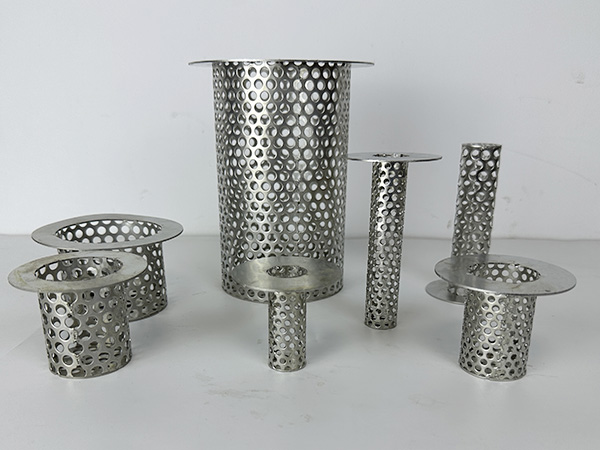
Filter cartridge
| Parameter | Common Range |
|---|---|
| Diameter | Inner: 10 mm – 150 mm; Outer: 20 mm – 200 mm (customizable) |
| Length | 50 mm – 1000 mm (standard lengths: 100 mm, 200 mm, 300 mm, 500 mm) |
| Flange Diameter | 50 mm – 250 mm (matches cartridge outer diameter) |
| Hole Size | 0.5 mm – 10 mm (common: 1 mm, 2 mm, 3 mm, 5 mm) |
| Open Area | 20% – 60% (depends on hole size and layout) |
| Thickness of Perforated Sheet | 0.5 mm – 3.0 mm (typical: 1.0–2.0 mm) |
The filter cartridge is a hollow cylindrical filter element mainly made of metal wire mesh as the filtering medium, processed by cutting, rolling, welding and other processes. It is the core consumable of industrial filtration systems, designed specifically for deep filtration, particle retention, and solid-liquid/gas separation under high pressure difference and high flow conditions.
Core features: deep filtration, strong structure, and wide applicability
Deep three-dimensional filtration: Unlike surface filtration, when the fluid passes through a multi-layer mesh structure, particles are captured inside the depth of the filter material, which has a large capacity for dirt and a long service life.
Mechanical strength of the effect: The cylindrical structure can effectively withstand fluid pressure from inside to outside or from outside to inside, and has good deformation resistance, especially suitable for high-pressure pipeline systems.
Excellent reprocessing ability: The filter cake deposited on the surface can be effectively removed through reverse washing, ultrasonic cleaning, and other methods. Most products can be reused, reducing the overall cost of use.
Wide range of precision and material selection: Different mesh sizes can be combined to achieve a wide range of precision from coarse filtration to relatively fine filtration (usually from a few micrometers to several hundred micrometers). The substrate selection is diverse to adapt to various chemical and temperature environments.
Low flow resistance and high flux: A uniform mesh structure causes relatively less resistance to the fluid, allowing for higher flow rates to pass through.
Common installation and usage issues of wire mesh in mine support
Rolled mesh is widely used in mine support (commonly used as roadway surface protection and isolation of gravel) due to its good strength, flexibility, and relatively easy installation. However, in complex underground environments, its installation and us
2025-12-03
Troubleshooting of wrinkling or wavy edges on the surface of the rolled mesh
The surface wrinkling and wavy edge (also known as "lotus leaf edge") phenomenon that occurs during the production or use of rolled mesh is a typical defect that affects the flatness, performance, and appearance of the product. Its roots are complex and i
2025-12-03
Surface treatment process of stainless steel woven mesh
The surface treatment of stainless steel woven mesh goes far beyond aesthetics. It is a meticulous forging process for substrates, aimed at greatly improving corrosion resistance (based on actual reports), wear resistance (based on actual r
2025-12-03
Technical application of stainless steel woven mesh in screening, filtering and shielding industries
Stainless steel woven mesh plays an excellent role in the industrial technology industry due to its strength, corrosion resistance (based on actual reports), designable accuracy, and stable physical properties. Its application in the three core industries
2025-12-03